Executive summary
The research in this paper was done by AI. An entire organization of Claude Opus 5.5 and GPT-6 Astra agents ran on Nenya, Durable Intelligence's harness for durable, ultra-long-horizon agent work, and carried a frontier research program on agent harnesses from mission to results: three days of experiments and 3,230,847 Claude Opus 5.5 calls, conducted by an agent named frontier-bond. The organization improved harnesses with one recursive loop, evidence-gated recursion (EGR). A model proposes a change, a gate admits it only on hard evidence, and the harness keeps and reuses it. EGR ran at four levels, from the parts of a harness up to Nenya itself, and every level improved on work it had never seen.
Findings
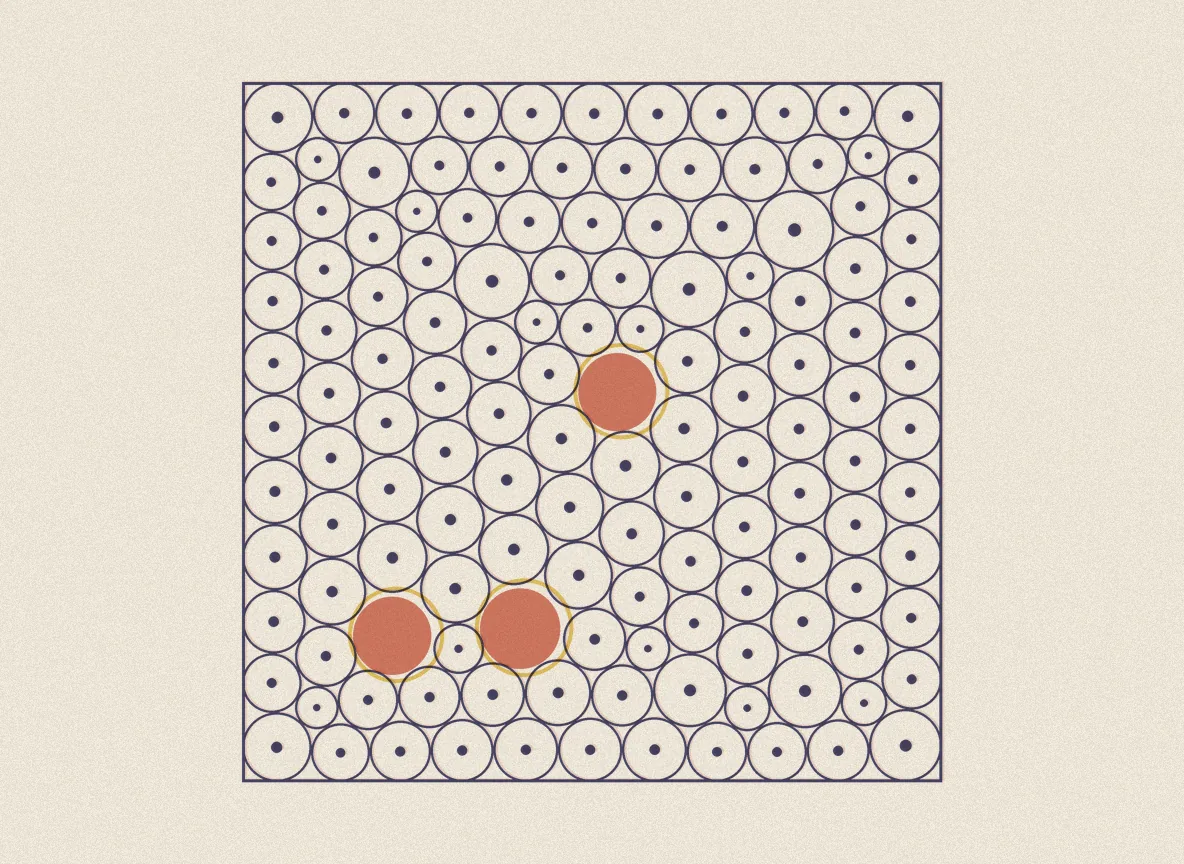
- 325 best-known mathematical values with exact certificates, including M ≤ 0.380856547875… for Erdős's minimum overlap problem, 20.3 times the Einstein Arena's minimum improvement below its record, and 306 record circle packings from N = 137 to 10,000.
- Model-written checks raised the catch of never-seen failures from 7.3% to 95.6%. An automatically evolved agent engine beat ACE on seven problem families it had never seen, lifting Claude Haiku 4.5 45% above its bare model.
- A running system repaired its own memory across a model upgrade, turning a store that slowed its new model into one that lifted it. At the top level, EGR rebuilt Nenya itself from the program's findings.
- On the same model, the harnesses beat CORAL (914 against 948 cycles) and ACE (3.67× against 1.95×) head-to-head.
- The headroom law: a component converts only the failures whose cause it supplies, so its lift scales with the headroom its model leaves (k = 0.54, 95% CI 0.43–0.68), and a share learned on weaker models outpredicts constant and capped gains on the frontier model. It explains why EGR compounds while recursion that admits changes on conclusions degrades.
The constructions, the exact checkers that certify them and a driver that reruns every check are released with the paper. The full recheck runs in under a minute on one CPU core.
Paper and data
PDF · 92 pages · 2.8 MB
ZIP · 13 MB · SHA-256 484ab7e805eeddd88485f74f3ecf96ff1e4b2b320791c49b426fe37c0f2bdb13